Patients Decide Within Three Minutes Whether They Trust You
Before the consultation begins. Before the chart is reviewed. Before any clinical interaction. A patient walking into a medical practice has made an initial trust assessment of that practice based almost entirely on the physical environment they've entered. This is not conjecture; it's documented in healthcare satisfaction research. The physical environment is the first proxy for clinical quality, because it's the first thing a patient can actually observe.
A waiting room with stained carpet, generic artwork from a hospital supply catalog, and fluorescent lighting that washes out every skin tone in the room communicates something specific: That this practice either doesn't care about patient experience or doesn't have the resources to address it. Neither message builds confidence before a clinical encounter.
Conversely, a medical practice with a thoughtfully designed, calming, clearly organized environment where the materials are quality, the lighting is appropriate, the wayfinding is intuitive, and the space communicates genuine attention, starts the patient relationship on a completely different foundation. The clinical outcomes in that environment benefit from that foundation, because patients who feel safe and confident engage more openly with their providers.
This is the business case for medical office design. Not aesthetics for its own sake — an investment in the patient experience that directly affects practice performance.
The Scottsdale Medical Market Is Competitive
Healthcare in the Scottsdale and Phoenix metro area operates in one of the most competitive private practice environments in the country. The concentration of high-income residents, the prevalence of concierge medicine models, the strong medical tourism and aesthetics industry, and the presence of nationally ranked hospital systems all create a market where differentiation matters at the practice level.
A private practice competing for patients in North Scottsdale — whether that's a primary care concierge practice, an ophthalmology group, a dermatology practice, a dental specialty office, or a medical spa is competing against practices that may have comparable clinical credentials. The physical environment becomes a meaningful differentiator in a market where patients have genuine choice and are making selection decisions based on the full experience rather than clinical reputation alone.
We've designed medical environments ranging from boutique concierge practices to dental specialty offices to comprehensive medical spa environments. In every case, the design brief starts with the same question: What does this patient feel when they're in this space, and does that feeling serve the clinical relationship?
Waiting: The Experience You Can't Eliminate, So Design It Right
Waiting is unavoidable in most medical practices. But the waiting experience is entirely controllable through design. The design elements that transform waiting from anxiety-producing to genuinely tolerable:
Spatial Arrangement
Healthcare researchers have found that patients feel more comfortable in waiting environments that offer seating choice — some chairs against walls (offering the psychological "back protection" of refuge seating), some chairs at angles, some small clusters for parties arriving together. The institutionalized row-seating against all four walls maximizes capacity and minimizes human dignity. Good waiting area design treats capacity and comfort as compatible goals rather than competing ones.
Natural light in the waiting area has a measurable effect on patient anxiety levels. A waiting room with access to natural light and views of natural elements, even a small courtyard or planted exterior wall visible through windows, produces lower reported anxiety than a waiting room in an interior space with artificial light only. In Arizona, where natural light is abundant, a practice that hasn't created access to it in the waiting area has missed an inexpensive and powerful amenity.
Acoustic Privacy
The check-in counter and reception desk area is a HIPAA conversation zone. Patient names, appointment types, insurance information, and clinical reason-for-visit are exchanged at this counter. When that exchange is audible to everyone in the waiting room, because the counter is open and the space is reflective, both privacy compliance and patient dignity suffer.
Good reception desk design incorporates acoustic privacy strategies: Solid partitions between check-in stations, sound-masking systems calibrated to the frequency range of speech (not the generic white noise machines that are obvious and annoying), and counter heights and barriers that create visual and acoustic separation between the transaction zone and the waiting area.
Distraction and Engagement
Waiting room television, broadcasting daytime programming or, worse, news channels with anxiety-producing content, is the worst form of ambient media for a medical waiting environment. Patients in medical settings are often already anxious, adding stressful media compounds that anxiety.
Better options: Curated content on screens, nature imagery, calm abstract video, or informational content specific to the practice's specialty. Access to charging stations (patients' own phones are their best distraction). Reading material that's actually interesting and current. In a concierge or high-end practice context, refreshment service, coffee, sparkling water, the occasional fresh fruit, signals that the practice views patient waiting time as valuable and worth acknowledging.
Clinical Space: Where Efficiency and Environment Intersect
The clinical areas of a medical practice, exam rooms, treatment rooms, procedure spaces, require design that serves both the patient's experience and the clinician's workflow. These are not competing goals, but they require explicit coordination.
Exam Room Layout
The layout of an exam room affects every clinical interaction that happens in it. Poor exam room design produces situations where the provider is working with their back to the patient (because the computer workstation is on the wrong wall), where the patient is positioned in a way that feels vulnerable (exam table facing the door, no privacy from hallway), or where the room is so crowded with equipment that the conversation between provider and patient feels like an afterthought.
We design exam rooms with specific consideration for the primary clinical workflow: Where the provider sits or stands relative to the patient, where the computer is positioned relative to both, where equipment is stored and accessed, and how the space allows for a genuine conversation rather than a transaction. The result is an exam room that feels less like a clinical processing station and more like a private consultation space which is good for patient experience and good for the clinical relationship.
Material Durability and Infection Control
Clinical spaces have specific material requirements that are non-negotiable. Flooring must be cleanable to healthcare standards, sheet vinyl or large-format porcelain with minimal grout lines, not carpet. Countertops must resist disinfectant chemicals; laminate and many natural stones are not appropriate. Wall surfaces in clinical zones must be washable. Hardware must be antimicrobial or easily cleanable.
None of this prevents good design. The current generation of healthcare-grade materials is genuinely excellent, luxury vinyl plank in realistic wood looks, porcelain in large format with minimal grout, solid surface countertops in sophisticated color palettes, high-performance paint finishes that resist cleaning chemicals and maintain appearance. The design vocabulary has expanded significantly beyond the institutional beige-and-grey of older healthcare environments.
Lighting in Clinical Spaces
Exam rooms need dual lighting modes: A higher-intensity, high-CRI (color rendering index) light for clinical examination that accurately renders tissue and skin tone, and a lower, warmer ambient light for the consultation portions of the visit. These are not the same light, and providing both through layered lighting design is a straightforward but often overlooked specification.
Task lighting at examination areas as dedicated fixtures at the exam table, at procedure zones, at the workstation, rather than relying entirely on overhead ambient lighting produces better clinical illumination and a more controlled, professional-feeling space.
Medical Spas and Aesthetics Practices: The Luxury Expectation
Medical spas and aesthetics practices in Scottsdale operate in a particularly demanding design environment. Their clientele expects luxury, they're spending $500–$3,000 per visit on aesthetic procedures, and they're comparing the physical experience of that visit to the luxury retail, salon, and hospitality environments they also frequent.
A Med Spa designed to a standard residential renovation quality level will disappoint clients whose baseline aesthetic experience includes Four Seasons lobbies and Neiman Marcus fitting rooms. The design has to meet that standard in materials, in finish quality, in spatial calm, and in the sense of being in a curated environment rather than a clinical facility that has been softened.
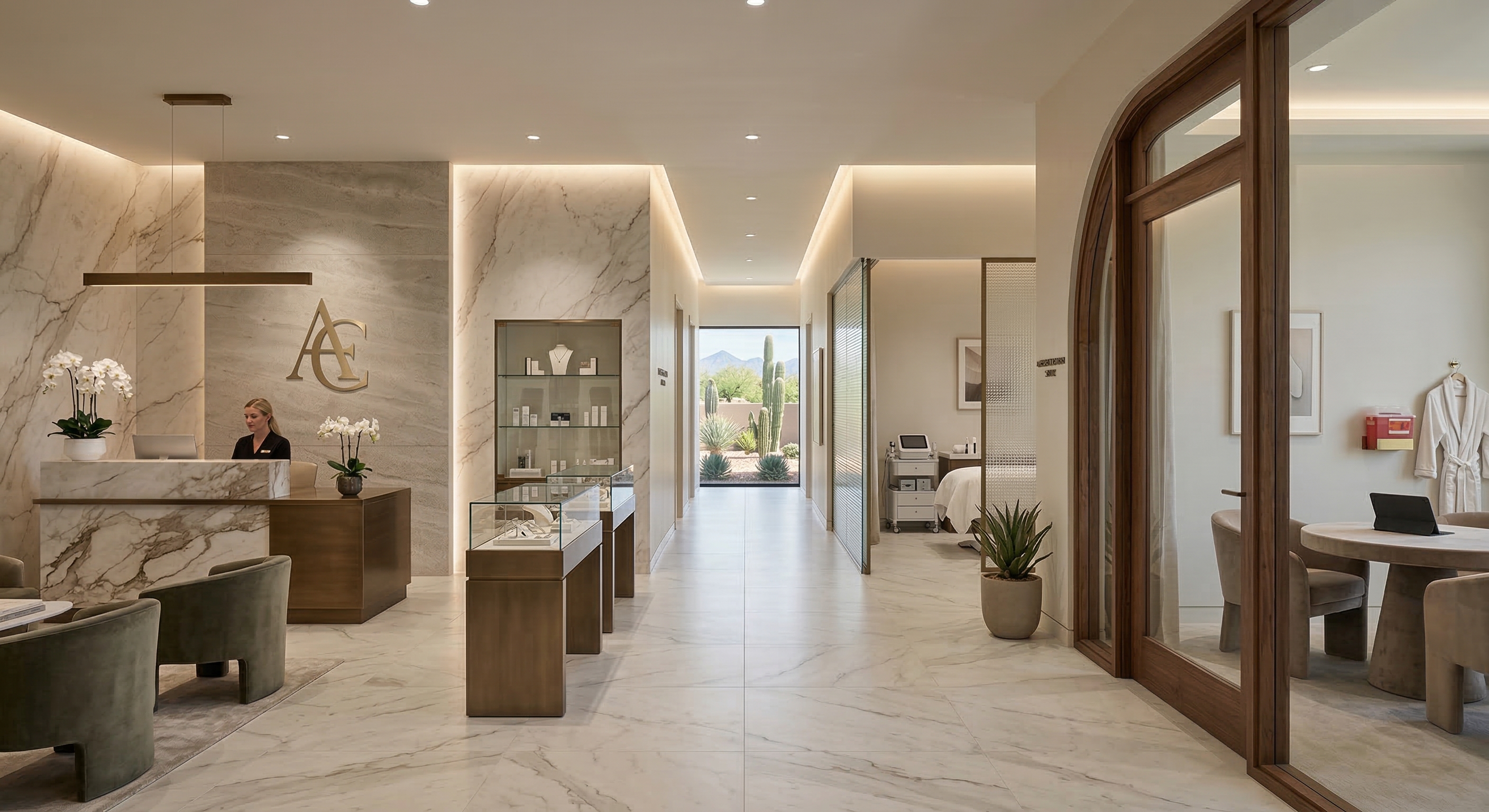
The elements that distinguish high-performing Med Spa design in Scottsdale: Reception that reads as a luxury boutique entry rather than a medical front desk; a consultation room designed for intimate, private conversation about aesthetic goals; treatment rooms with the calm, spa-quality environment that puts clients at ease before and during procedures; retail display that presents skincare and product with the visual merchandising quality of a high-end cosmetic counter.
All of this has to be achieved within the regulatory requirements for a licensed healthcare facility, which means the aesthetics-forward design operates on top of a compliant clinical infrastructure, not in place of it.
Brand Coherence: From Physical Space to Digital Presence
A medical practice's physical environment and its digital presence should tell the same story. A beautifully designed practice that has a generic website and no social presence is leaving a meaningful amount of new patient acquisition on the table. Conversely, a practice with a strong digital brand and compelling content that leads prospective patients to a disappointing physical environment creates a broken brand experience.
This is where our relationship with Firebrand Agency, our sister company specializing in brand identity, web design, and digital marketing, is genuinely valuable for medical practice clients. When Park Avenue Design, Inc. handles the physical environment and Firebrand handles the brand identity and digital presence simultaneously, the practice gets a coherent experience across every patient touchpoint: the website, the social media presence, the physical space, the patient communications.
Practices that have worked with both firms report a meaningful improvement in new patient acquisition quality; patients who arrive having already formed a positive impression based on the digital presence, and whose experience of the physical space confirms that impression rather than contradicting it. For practices in the competitive Scottsdale aesthetics and concierge medicine market, this coherence is a genuine competitive advantage.
Design Specifications That Affect Healthcare Compliance
Medical practice design in Arizona requires coordination with regulatory requirements that residential design does not encounter. Arizona Department of Health Services has licensing requirements for certain types of medical facilities. HIPAA affects how reception, consultation, and clinical spaces must be configured for privacy. ADA compliance is required for all commercial facilities, with healthcare-specific requirements for exam room and restroom accessibility.
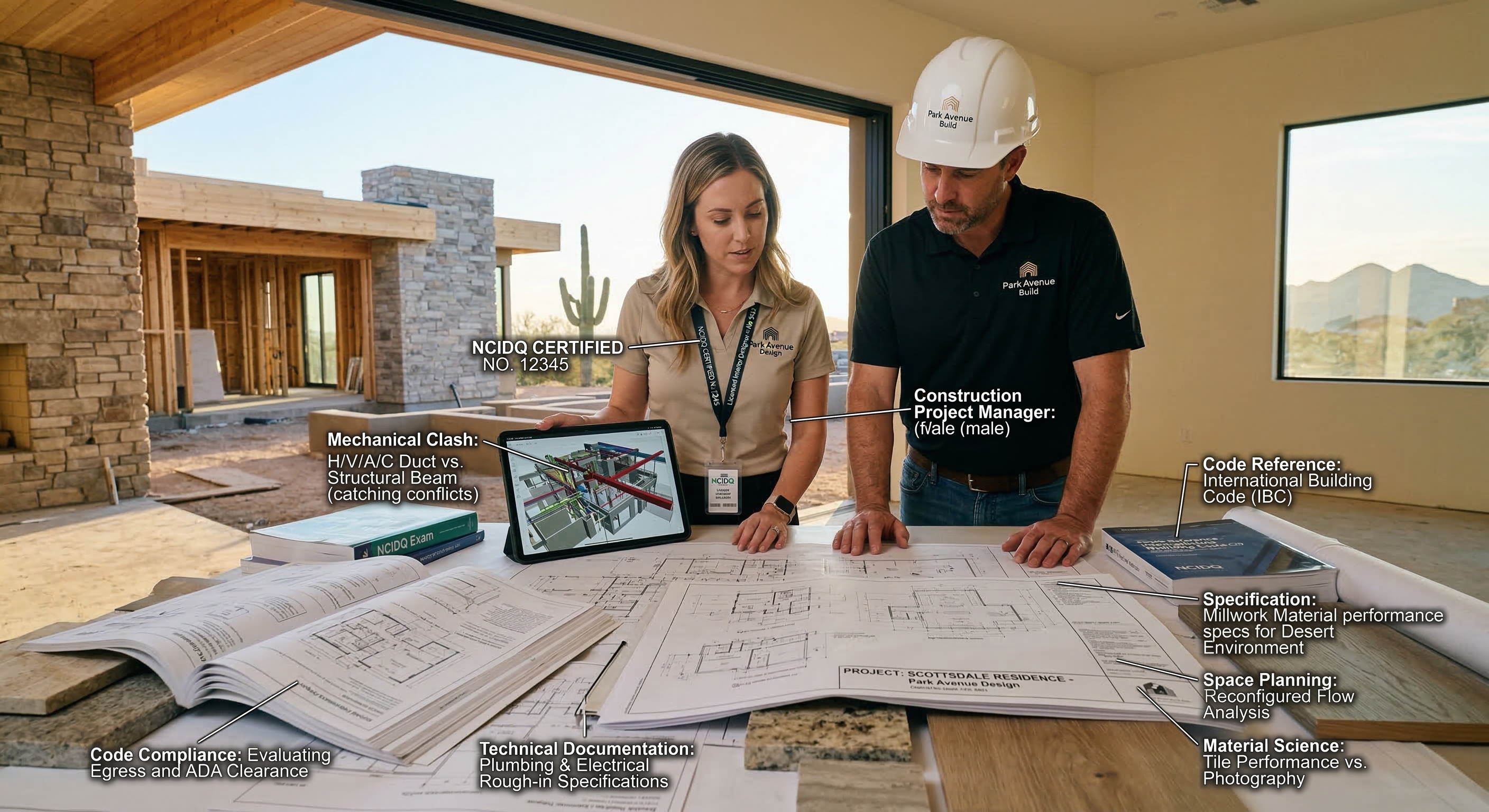
We work with healthcare consultants and regulatory specialists on projects that require this expertise, and we coordinate design specifications with the compliance requirements from early in the design process rather than discovering compliance conflicts after specifications are finalized. This is the same disciplined coordination approach we bring to all commercial projects; design decisions made with full knowledge of the constraints they must work within.
Starting the Conversation
Medical practice design projects typically begin with a needs assessment: How does the practice actually function, what are the patient flow patterns, where are the current physical environment's most significant failures, and what is the vision for the practice's patient experience going forward? That conversation leads to a design brief that drives everything that follows.
If you're opening a new practice in Scottsdale or the greater Phoenix area, relocating an existing practice, or renovating a space that's no longer serving your clinical team or your patients, we'd welcome an initial conversation. Design fee structures for commercial medical projects are based on scope — we provide a specific proposal after an initial assessment of the project.
Reach Gabrielle Roeckelein, ASID, NCIDQ at Park Avenue Design: (480) 961-7779 or visit parkavenuedesign.com/contact-us. For more on our commercial capabilities, read about our commercial interior design services and our approach to restaurant and hospitality design.
Gabrielle Roeckelein, ASID, NCIDQ — Park Avenue Design, Inc. | Scottsdale, Arizona