The Question Everyone Asks — and Most Designers Avoid Answering Directly
Clients ask about timeline in the first meeting, and most designers give some version of "it depends." That's not entirely wrong, but it's also not very useful. You have a life. You have a family event planned, a guest arriving, a lease expiring. You need a real answer, or at least a realistic range.
After 25 years of interior design projects in Scottsdale and the surrounding communities, I can give you that range. Not a guarantee, but construction schedules, custom production lead times, and client decision-making speed all have a vote. But a genuine, experience-based picture of how long projects of different types actually take.
The Phases That Drive Every Timeline
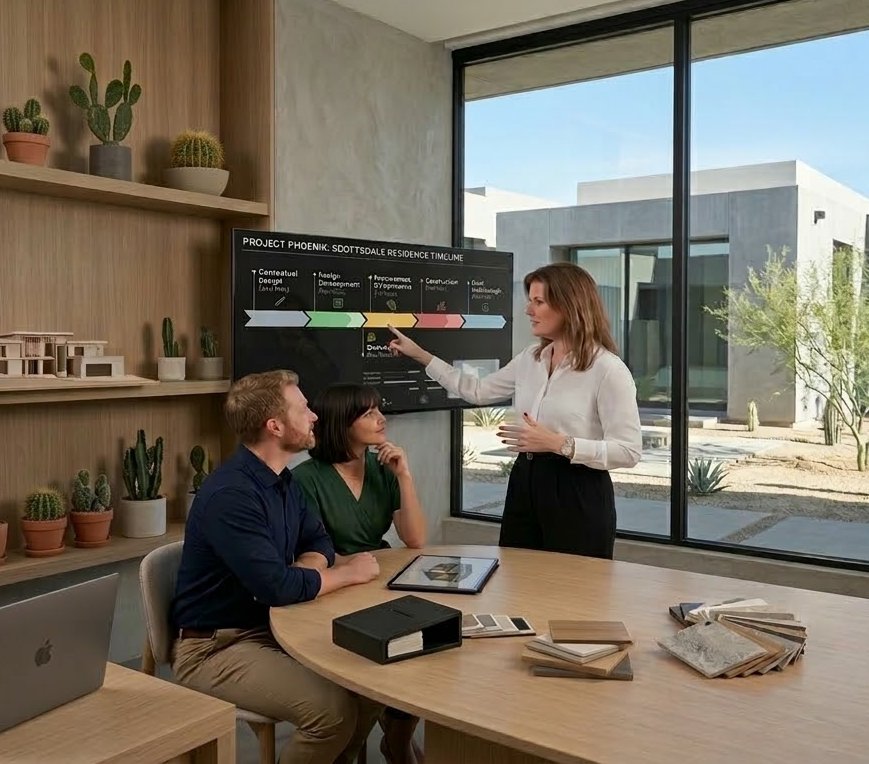
Before getting into project-specific timelines, it helps to understand that every design project moves through roughly the same phases. Each one has a minimum time floor that can't be compressed without consequences.
- Discovery and programming — Understanding how you live, what you need, what you don't want
- Concept development — Direction setting, space planning, preliminary material palettes
- Design development — Full specification of all materials, furniture, fixtures, and finishes
- Client approval — Review, revision, and sign-off on all selections
- Procurement — Ordering all specified items, tracking production and delivery
- Construction / renovation — Where applicable
- Installation and styling — Furniture delivery, art hanging, final styling
These phases can overlap and procurement often starts before all specification is complete, but they can't be eliminated. The fastest projects skip steps. The results show it.
Timeline by Project Type
Single-Room Redesign (No Construction)
Typical timeline: 4-8 weeks
A bedroom, living room, or home office where the layout and structure stay as-is. New furniture, finishes, accessories, and window treatments. No contractors involved.
The main variable: furniture lead times. Custom upholstered pieces typically run 6-10 weeks from order to delivery. If you're open to in-stock options, timelines compress. If you want custom everything, 12 weeks is a realistic floor.
The other variable: decision speed. A client who reviews mood boards and responds within a day moves through design development in 2–3 weeks. A client who needs to think, confer, sleep on it, and reconsider adds weeks at every approval gate.
Pro Tip: If you have a hard deadline such as a holiday gathering, a family arrival or the like, work backwards from it. 16 weeks is about four months. If your Thanksgiving is in November, you need to be signing a design agreement in late July.
Bathroom Renovation
Typical timeline: 2-4 months from design start to completion
A primary bath renovation involves tile, stone, cabinetry, plumbing fixtures, lighting, and mirrors. It requires a contractor and likely a plumber, electrician, and tile setter. Permit timelines in Scottsdale and Paradise Valley vary and most straightforward bath remodels don't require permits, but anything involving structural changes or relocating plumbing does.
The tile and stone selection alone deserves a few weeks. We want to see slabs in person, not on a sample chip, before specifying. Countertops and shower surrounds need to be templated after demolition, which adds fabrication lead time of 2–4 weeks for stone.
Construction on a primary bath typically runs 4-8 weeks, depending on scope and contractor availability.
Kitchen Renovation
Typical timeline: 3-6 months from design start to completion
Kitchens are the most complex single-room renovation because every trade is involved simultaneously: cabinetry, plumbing, electrical, tile, stone, appliances, lighting. Sequencing errors are costly, if the cabinetry is installed before the electrician has finished rough-in, somebody is doing rework.
Custom cabinetry is the long-lead item in most kitchen projects. Expect 6-8 weeks from order to delivery for quality semi-custom cabinets, and 8-12 weeks for fully custom. Appliances have improved in lead time post-pandemic, but specialty items like an integrated refrigeration, professional-grade ranges, can still run 8–12 weeks.
If your kitchen project involves moving walls or relocating the range hood (which means re-routing ductwork), add time for structural work and permitting.
Primary Suite (Bedroom + Bath)
Typical timeline: 4–7 months
The combination of a bedroom redesign with a bath renovation is one of our most common project types in Scottsdale's luxury residential market. The bedroom side drives the procurement timeline (custom furniture, window treatments, bedding, art). The bath side drives the construction timeline. They often run in parallel, which is one of the advantages of having a single designer coordinate both.
Whole-Home Renovation (Existing Structure)
Typical timeline: 8-12 months
This is the most common place where timeline expectations diverge sharply from reality. Homeowners who've seen a full-home renovation done on television in 48 minutes have a reference point that has nothing to do with how projects actually work.
A whole-home renovation in a 3,500–6,000 square foot Scottsdale home involves months of design development before a single contractor is on-site. Every surface, every fixture, every built-in, every piece of furniture needs to be specified, priced, approved, and ordered in the right sequence. Construction itself, with the trades coordinated, typically runs 6–12 months. Furnishings installation follows after construction is complete.
The 12-month floor assumes a relatively smooth process. If there are structural discoveries during demolition and there almost always are something, if the contractor has scheduling conflicts, or if a major item is damaged in transit and must be reordered, 12 months is realistic. Plan for it.
New Construction Interior Design
Typical timeline: 14-24 months
Working alongside an architect and builder from the early design phase, which is when you should bring in a designer, not after the plans are done. It involves a long, parallel process. Material selections need to be made at specific construction milestones. Plumbing and electrical rough-ins have to be coordinated with fixture specifications. Cabinetry shop drawings need review before fabrication starts.
The longest variable in new construction is often the build itself. Scottsdale-area custom home construction runs 14–24 months from permit to certificate of occupancy for homes in the 4,000–8,000 square foot range. Interior design runs alongside and finishes after. Furnishings delivery and installation typically happen in the final 2–3 months of the timeline.
The Variables That Compress or Extend Any Timeline
Decision Speed
This is the single biggest variable that client's control. A client who can make a confident decision in 48 hours moves a project dramatically faster than one who needs three weeks to approve a tile selection. Neither approach is wrong and some decisions warrant extended consideration. But if you're working toward a deadline, decision agility is the lever you have the most control over.
Contractor Availability
Scottsdale's and the greater Phoenix Area's custom home market is active. Quality contractors are not sitting around waiting for projects. If you're planning a renovation, establishing a contractor relationship early and ideally before the design is complete and protects your schedule. We have working relationships with contractors we trust and can facilitate introductions.
Permit Timelines
Most cosmetic renovations don't require permits. Anything structural, anything involving significant electrical or plumbing changes, anything that changes the building envelope does. Scottsdale's permitting office has variable response times — straightforward permits may be approved in 2–4 weeks; complex projects can run 8–12 weeks. We factor this into scheduling.
Custom Lead Times
2026 is an interesting moment for supply chains. Tariff pressure on imported goods is real, and some manufacturers are managing allocation carefully. We try to source heavily from domestic manufacturers such as cabinetry, tile, fixtures, furniture — in part because we know their lead times and trust their quality. When we do specify imported items, we order early and account for potential delay.
Scope Creep
Projects expand. A kitchen renovation turns into a kitchen and dining room renovation when the client sees what the kitchen transformation does to the adjacent space. That's not unusual and not necessarily bad but it adds time. Having an honest conversation about where expansion is likely to happen, and building some schedule buffer for it, is better than being blindsided mid-project.
How to Set Yourself Up for a Smooth Timeline
- Start earlier than feels necessary. The most common thing I hear from clients is "I wish we had started sooner." If you're targeting a specific season for completion, add six months to whatever date you think you need to start.
- Be decisive, with good information. Decisions made with thorough information are more durable. We present well-researched options and not infinite possibilities so you can decide with confidence.
- Communicate changes immediately. If something in your life changes, say a budget shifts, a family situation, or a travel conflict, please tell us right away. Early adjustments cost far less than late ones.
- Trust the process. Some steps feel slow from the outside because the work is happening behind the scenes. Specification documents, order tracking, contractor coordination. None of it is visible to you, but all of it is moving.
For more on what the design process looks like from start to finish, read What Does an Interior Designer Actually Do? And if you're ready to start your own project, What to Expect During Your First Interior Design Consultation will help you prepare.
Let's Build Your Project Timeline Together
Every project is different, and the best timeline conversation happens in context — knowing your specific rooms, goals, and any hard deadlines you're working toward. Park Avenue Design offers a complimentary consultation to Scottsdale, Paradise Valley, and North Scottsdale homeowners. Call Gabrielle Roeckelein, ASID, NCIDQ at (480) 961-7779 or visit parkavenuedesign.com/contact-us.
Gabrielle Roeckelein, ASID, NCIDQ — Park Avenue Design, Inc. | Scottsdale, Arizona