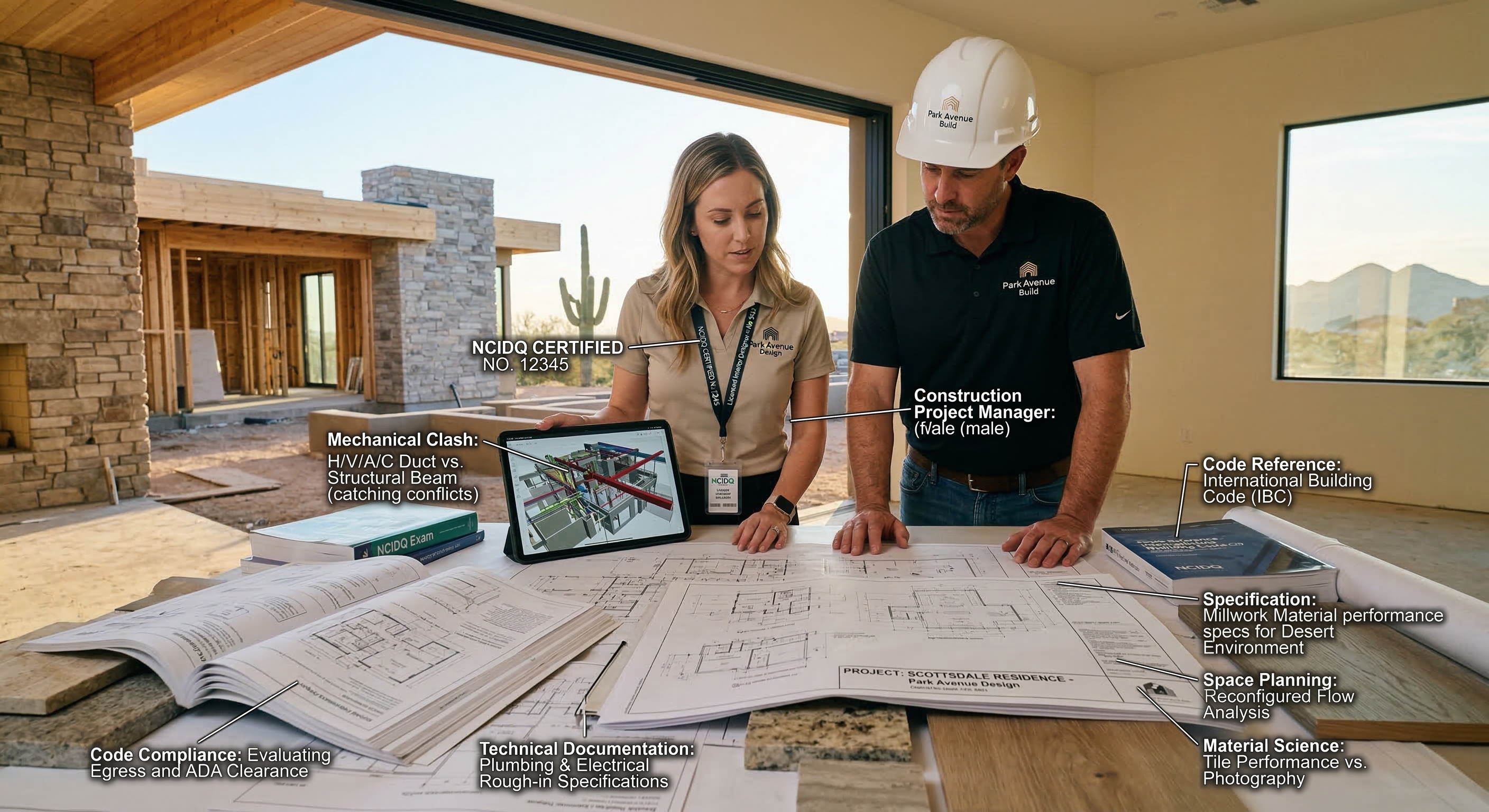
Credentials Exist for a Reason — and In Interior Design, This One Is the Standard
The design industry is crowded with titles. "Interior designer." "Interior decorator." "Space stylist." "Design consultant." Some of these represent rigorous professional preparation. Others represent nothing more than a business card and a social media account. If you're hiring someone to change your home in any substantive way, knowing the difference matters.
The NCIDQ certification is the primary professional credential for interior designers in North America. If you're hiring a certified interior designer in Scottsdale, or anywhere, and the credential matters to you, here's exactly what it means and why I'd encourage you to ask for it.
What NCIDQ Actually Is
NCIDQ stands for the National Council for Interior Design Qualification. It's an independent, nonprofit credentialing body that sets and administers the professional certification examination for interior designers across the United States and Canada.
Passing the NCIDQ exam is the threshold requirement for calling yourself a licensed, certified, or registered interior designer in most states with interior design practice acts. Arizona recognizes NCIDQ as the standard for professional credentialing in the field.
The exam has three sections, each testing different domains of professional competency:
- Fundamentals Examination: Covers building systems, materials, construction, environmental systems, and the technical knowledge base that underlies design practice
- Practicum Examination: Tests applied space planning under examination conditions, a real project problem that must be solved within time constraints
- Professional Practice Examination: Covers business practices, contracts, ethics, project management, and the legal and regulatory context for design practice
Before you can even sit for the exam, you must meet education and work experience requirements: an accredited interior design degree and a minimum of 3,520 hours of documented work experience under qualified supervision. The credential can't be earned through any shortcut.
Why These Aren't Just Formalities
Every section of the NCIDQ exam tests knowledge that has real-world consequences when absent.
Consider:
A designer who doesn't understand egress requirements might specify a room configuration that violates fire code. One who doesn't understand material performance might select a tile for a wet area that's dangerously slippery. One who doesn't understand structural loads might propose a built-in that can't be supported by the wall behind it.
Most of the time, none of these scenarios become emergencies. But the reason professional credentials exist is that "most of the time" isn't good enough when health, safety, and significant money are at stake. The NCIDQ exam tests whether a designer knows enough to identify these problems before they become your problem.
What It Doesn't Test
I want to be honest about what the NCIDQ does and doesn't measure. It tests technical competency and professional knowledge. It does not test aesthetic sensibility, creativity, communication skill, or the ability to listen well and translate a client's vision into a physical space.
A designer can be NCIDQ certified and still produce work that's technically sound but aesthetically undistinguished. The credential is a floor, not a ceiling. It tells you someone has the technical preparation to practice professionally. It tells you nothing about whether they're talented, warm, responsive, or a good fit for your specific project.
Evaluate both. The credential and the portfolio. The certification and the references. Technical competency is necessary but not sufficient.
ASID: The Professional Community That Goes Alongside It
I hold both NCIDQ certification and ASID membership at the professional level. The American Society of Interior Designers requires NCIDQ (or equivalent) for professional membership, it's not a club anyone can join with a check. ASID members also commit to continuing education and a professional code of ethics.
The continuing education piece matters to me personally. I attend CEU classes regularly, go to virtually every major furniture market in Las Vegas, High Point, NC and travel internationally every year to maintain direct relationships with artisan sources. The field evolves, materials, technology, building science, sustainability standards, and production processes all change. Credentials earned a long time ago only stay meaningful if the person holding them keeps up.
How to Verify a Designer's Credentials
You don't have to take a designer's word for it. NCIDQ maintains a public directory of certificate holders at ncidq.org. ASID membership can be verified at asid.org. Arizona also maintains state records of registered interior designers through the State Board of Technical Registration.
Ask any designer you're considering: "Are you NCIDQ certified?" and "Are you an ASID member?" A designer worth hiring will answer immediately and without defensiveness. One who hedges or pivots to portfolio discussion when you ask about credentials is telling you something.
The Question Behind the Credential
The real question the NCIDQ answers isn't "did this person pass a test?" It's: "Has this person invested seriously in their professional preparation, demonstrated competency to an independent third party, and committed to the ethical standards of the profession?"
In a field where anyone can call themselves a designer, that question has a meaningful answer.
For more on how credentials translate to the work itself, read Interior Designer vs. Interior Decorator: What's the Difference. And when you're ready to start asking the right questions of any designer you're considering, 10 Questions to Ask Before Hiring an Interior Designer gives you a complete framework.
Work With a Credentialed, Experienced Designer
Gabrielle Roeckelein, ASID, NCIDQ has been practicing interior design in Scottsdale for over 25 years. Park Avenue Design, Inc offers a complimentary consultation for residential and commercial projects. Call (480) 961-7779 or visit parkavenuedesign.com/contact-us to start the conversation.
Gabrielle Roeckelein, ASID, NCIDQ — Park Avenue Design, Inc. | Scottsdale, Arizona