The Room That Never Gets Done Right Is Usually the Primary Suite
In nearly every home renovation we take on, the same pattern emerges: The kitchen got attention, the great room got attention, the powder bath got the gorgeous wallpaper, and the primary suite, the room the owners actually sleep in every night, is still furnished with the "temporary" pieces from the last house and a bedside lamp that doesn't quite reach where it needs to.
Homeowners defer their own room. They prioritize shared spaces, guest rooms, even closets. The primary suite waits. And then one day they realize they've spent $300,000 on a home renovation and the room they spend eight hours in every night still doesn't feel like it belongs to the rest of the house.
Designing a primary suite in Scottsdale is one of my favorite project types, because the transformation, when it's done right, is genuinely life-changing. A well-designed primary suite doesn't just look better. It changes how you experience coming home.
Start With the Feeling, Not the Furniture
The question I ask first isn't "What do you want the room to look like?" It's "How do you want to feel when you walk in?"
The answers vary significantly between clients, and they should, because your primary suite should be unmistakably yours, not a replication of a hotel or a trend. Some clients want an enveloping, cocoon-like retreat: Low light, deep colors, textural richness. Others want an airy, serene space with morning light and nothing superfluous. Others want a glamorous, dressed-up room that makes them feel elevated the moment they enter.
None of these is right or wrong. But each one requires fundamentally different decisions about color, lighting, materiality, and furniture, and a designer who starts with the furniture catalog before understanding the feeling will get it wrong every time.
The Bedroom Itself: Key Design Decisions
Bed Wall and Headboard
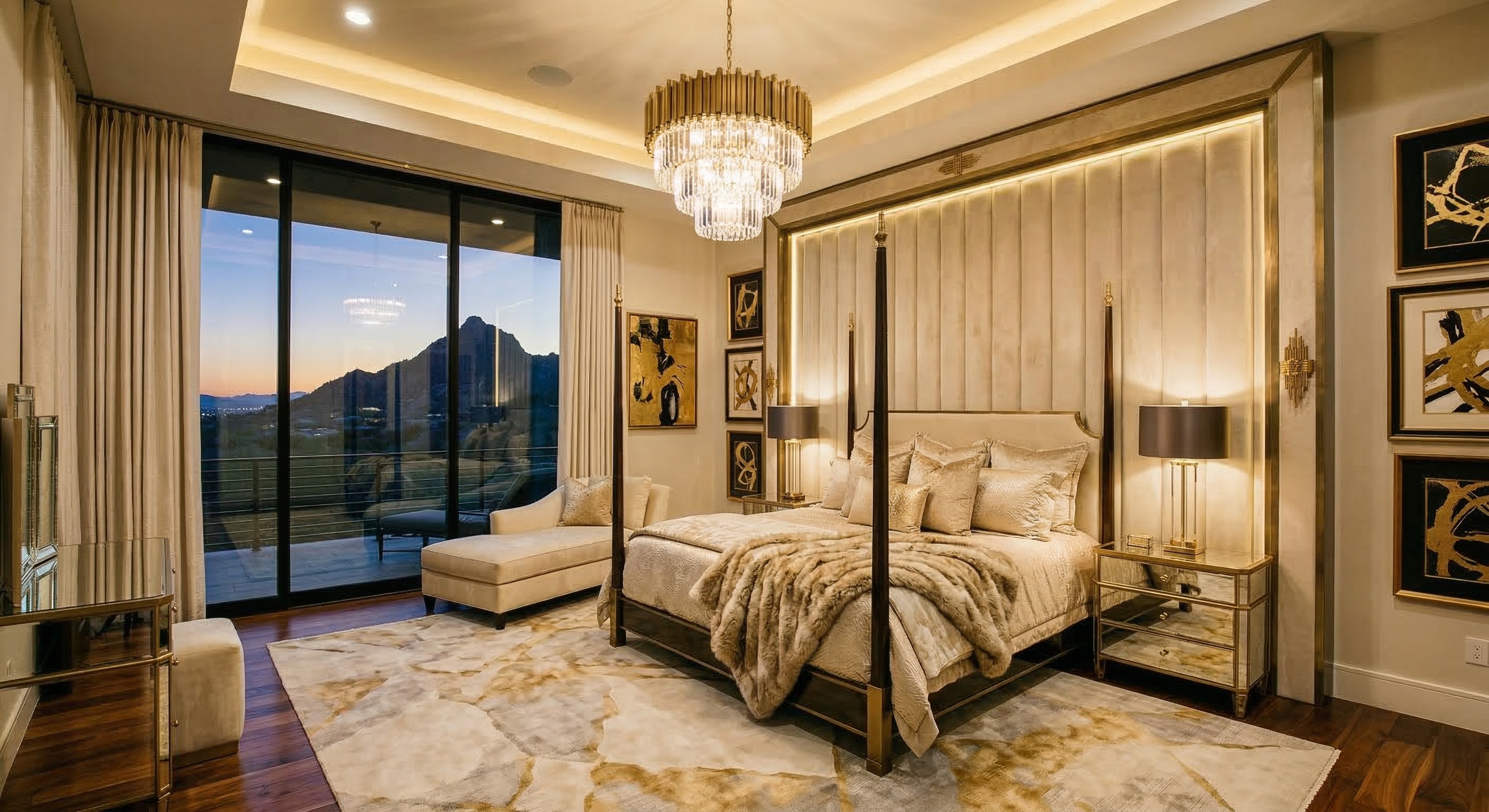
The bed wall anchors the entire room, and how you handle it sets the tone for every other decision. Options range from a floating, architecturally simple bed against a painted or wallpapered wall, to a fully built-in headboard-to-ceiling millwork treatment that creates a hotel-suite drama.
In Scottsdale homes with 10- to 12-foot ceilings, which are common in custom and semi-custom construction in communities like Troon, DC Ranch, and Silverleaf, a full-height bed wall treatment is almost always worth doing. It gives scale to a tall ceiling that would otherwise feel awkward above a standard-height headboard.
Upholstered headboards remain a staple in luxury bedrooms because of their acoustic properties and visual warmth. We specify custom upholstered headboards sized to the exact wall, not a catalog piece scaled up, typically running 80–96 inches wide for a king bed in a room with appropriate ceiling height. Fabric selection matters enormously: Performance velvets and treated linens are practical for something you sit against regularly; silk and untreated linens are beautiful but less durable.
Ceiling Treatment
Nothing transforms a bedroom more affordably, relative to impact, than a ceiling treatment. A coffered ceiling, a simple cove detail, a plank ceiling in white oak or painted tongue-and-groove, these create architectural character that no furniture arrangement can replicate.
In Arizona, where rooflines often allow for dramatic ceiling pitch, a vaulted ceiling in the primary suite with exposed beam detail is one of the most requested design elements. It reads as authentically Southwest when done well, and purely architectural when the beams are painted to match the ceiling rather than stained dark.
Window Treatment and Light Management
This is a functional decision as much as an aesthetic one. In Scottsdale, east-facing bedrooms receive direct morning sun that can be harsh if uncontrolled. West-facing rooms get afternoon heat. Neither condition makes for good sleeping without proper window treatment.
For most primary bedrooms, we specify a layered window treatment: Blackout roller shades or woven wood shades as the primary light-control layer, with a fabric drapery panel over them for softness and room-darkening depth. Drapery hung at ceiling height and extending 6–12 inches beyond the window frame on each side makes windows look larger, ceilings feel taller, and rooms feel finished in a way that no other single element achieves as efficiently.
Lighting Plan
A single overhead fixture is not a bedroom lighting plan. A primary suite needs at minimum five lighting zones: General ambient (preferably recessed or architectural, not a prominent center fixture), bedside reading light (wall-mounted or pendant, not table lamps if bedside tables are narrow), accent lighting for art or architectural features, wardrobe or closet lighting if it's part of the suite, and, increasingly, a dimmable nightlight circuit for navigating the room at 2 a.m. without turning on a flood.
All primary suite lighting should be on dimmers. This is non-negotiable. The difference between an overhead recessed fixture at full brightness and the same fixture at 15% is the difference between a hospital and a retreat.
The En Suite Bathroom: Functional Luxury
Most Scottsdale primary suites include an en suite bathroom that warrants as much design attention as the bedroom itself, sometimes more, since the material and fixture decisions are more technical and more expensive to change after the fact.
Shower Design
The primary shower is almost always the centerpiece of a luxury bathroom renovation. Key decisions:
- Curb vs. Curbless: Curbless (zero-threshold) showers read as more modern and are significantly more accessible as homeowners age. They require careful floor slope execution, the entire floor must drain correctly, and a proper linear drain or center drain specification.
- Size: A functional walk-in shower for a luxury primary bath is at minimum 36" x 60", though 42" x 72" or larger allows for better placement of multiple shower heads and more comfortable daily use.
- Tile vs. slab: Large-format tiles (24x48 or larger) reduce grout lines and create a cleaner look in the shower. A slab surround, quartzite, marble, or porcelain slab, with minimal or no grout joints reads as the most luxurious option and is increasingly common in Scottsdale renovation projects.
- Shower heads: A fixed rain head, a hand-held, and a pair of body sprays is the standard specification for a primary bath shower in the luxury category. Thermostatic valve controls allow independent temperature setting for each outlet, a meaningful comfort upgrade.
Soaking Tub
The soaking tub is the most debated element in primary bath design. Clients often include it because it feels like a luxury marker, and then confess they rarely use it. My honest take: Specify a tub only if you genuinely enjoy soaking baths. If it's purely aspirational, the square footage is usually better used on a larger shower or a more generous vanity run. Special note: If you or your family have difficulty navigating steps (in general) due to joint, leg or back issues, please omit the soaking tub. (Think how you will have to “climb” in the tub.)
When we do specify a soaking tub, we site it thoughtfully: Ideally under a window with a view, on a platform, or in a dedicated alcove that gives it architectural purpose rather than just floating in the middle of the room.
Vanity and Storage
Separate vanities for each partner, rather than a shared double vanity, is the luxury primary bath standard for good reason. Each person has their own mirror, their own lighting, their own storage, and their own counter space. When space allows, we separate the vanities physically: One on each wall or separated by a partition.
Vanity height is worth discussing: Standard vanity height is 32–34 inches, but comfort height at 36 inches is increasingly common and preferable for most adults. Custom cabinetry allows this adjustment; stock vanity units typically don't.
The Closet: Underinvested, Overused
Most homeowners think of the closet as a functional necessity, not a design opportunity. We disagree. A well-designed primary closet, with appropriate lighting, logical organization, and materials that feel considered rather than purely utilitarian, makes the entire morning routine better. Closet systems with open shelving, dedicated drawer banks, a well-lit mirror, and an island with a countertop for laying out items are achievable in most primary suite closet footprints.
Budget note: A beautifully finished custom closet system runs $12,000 to $30,000 depending on size and material level. A stock modular system from a closet retailer might run $3,000 to $8,000. The difference is in the millwork quality, the hardware, and the precision of fit. For clients who use their closets extensively, the custom investment pays back in daily experience.
Budget Realities for a Scottsdale Primary Suite
A fully realized primary suite renovation, bedroom, en suite bathroom, and closet together — is one of the most significant investments in a home's interior. Realistic budgets for the luxury residential market in Scottsdale:
- Bedroom only (furniture, window treatments, lighting, no construction): $35,000 – $80,000
- Primary bath renovation (tile, stone, cabinetry, plumbing, fixtures): $60,000 – $160,000+
- Custom closet system: $12,000 – $30,000
- Suite total (all three, mid-range luxury): $130,000 – $250,000
These ranges reflect Scottsdale's custom residential market and the quality of materials and craftsmanship appropriate for luxury homes in communities like Silverleaf, Troon, DC Ranch, and Paradise Valley.
Ready to Design Your Retreat?
Park Avenue Design has designed primary suites throughout Scottsdale, Paradise Valley, and North Scottsdale that clients describe the same way: "It finally feels like me." If your bedroom is the room that keeps getting deferred, it's time to change that. Call Gabrielle Roeckelein, ASID, NCIDQ at (480) 961-7779 or visit parkavenuedesign.com/contact-us to schedule a complimentary consultation.
Gabrielle Roeckelein, ASID, NCIDQ — Park Avenue Design, Inc. | Scottsdale, Arizona