Big Rooms Don't Automatically Feel Good — and Most Don't
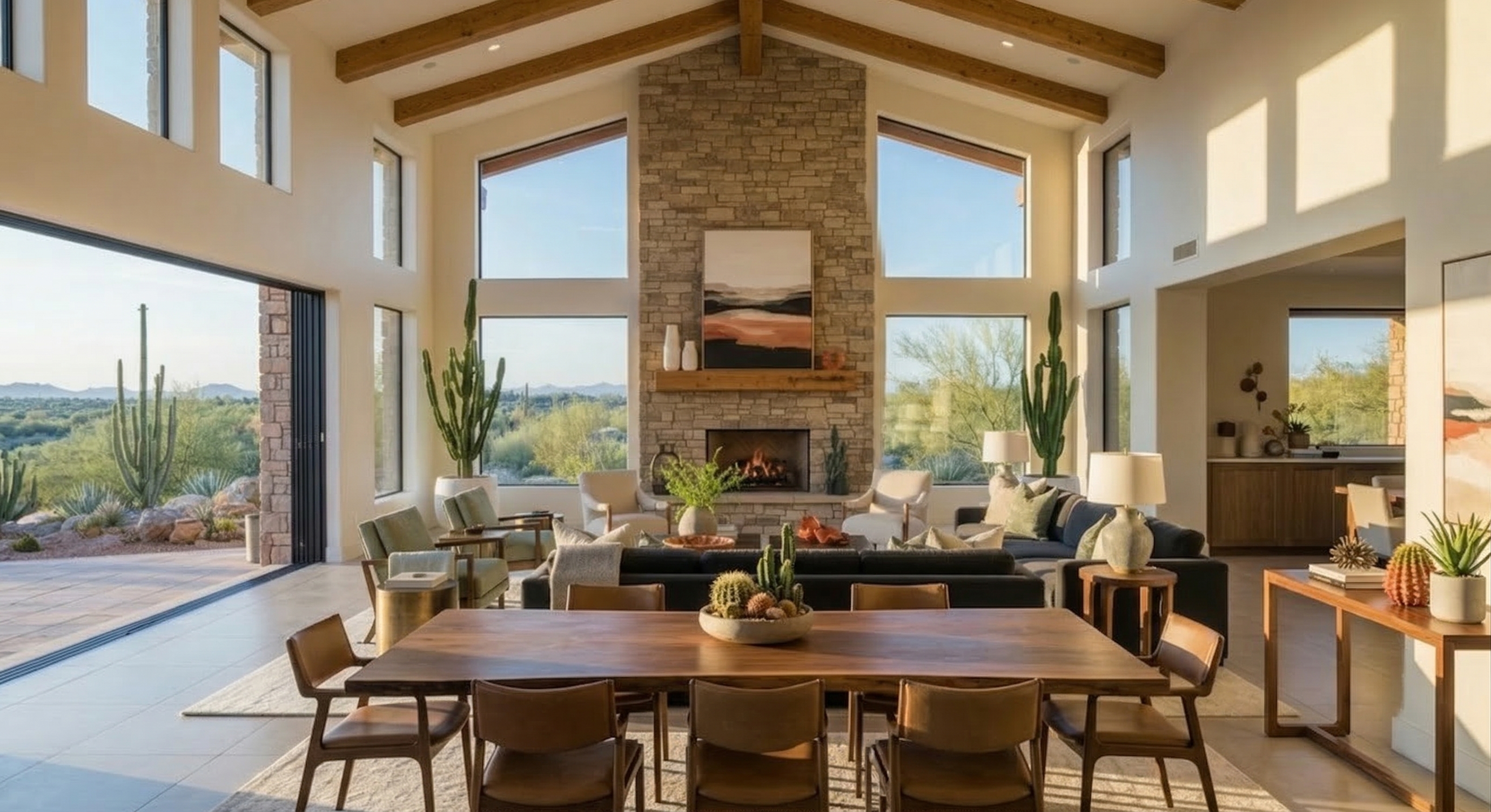
The great room was the defining floor plan move of luxury residential design for two decades. Knock down the walls, open the kitchen to the dining to the living, bring the outdoors in with glass walls and a view of the desert. It was, and still is, a beautiful aspiration.
What nobody talks about is how hard large open-plan spaces are to actually design. A 1,200-square-foot great room that contains a kitchen, dining area, and living zone is not three rooms. It's one room that has to function as three, feel like three, and hold together as one. That's a genuinely challenging design problem, and most people underestimate it until they're standing in a new home staring at a vast expanse of travertine and wondering why the room that looked so impressive in the builder's rendering feels so empty and awkward now that the furniture is in it.
Great room design in Scottsdale is one of the most common, and most mishandled, challenges in the luxury residential market. Here's how we think about it.
The Core Principle: Zones, Not Rooms
The foundational move in a great room design is creating distinct functional zones within the open plan, areas that feel intentional and complete within themselves while remaining visually connected to the whole. The goal is for someone standing at the kitchen island to see a living room that looks composed and finished, not a random collection of furniture floating in a large room.
Zones are established through a combination of:
- Furniture arrangement and scale — the most powerful zoning tool
- Area rugs — the single most effective way to define a zone visually
- Ceiling treatment variations — a coffered ceiling over the living zone, open to the kitchen, separates them architecturally
- Lighting zones — distinctly lit areas feel separate even in an open plan
- Flooring material transitions — tile to hardwood, or a change in wood orientation, signals zone transitions without walls
The most common mistake: Treating the entire great room as one furniture arrangement. A sofa facing a television, a dining table in the middle of the space, a kitchen island with barstools, no visual territory established for any of them, everything floating in the same infinite plane. It looks exactly as uncomfortable as it sounds.
Furniture Scale: The Mistake Almost Everyone Makes
Furniture undersizing is epidemic in large rooms. A homeowner who previously lived in a 2,000-square-foot house buys the same size sofa they had there and places it in a 1,200-square-foot great room, where it immediately disappears. The room looks sparse. They add more pieces. Nothing helps. The pieces are simply too small for the space.
Scale in a large room requires courage. Sofas that are 108–120 inches long rather than 84 inches. Coffee tables with genuine footprint, 54 x 30 inches or larger, rather than the modest pieces that look appropriate in a smaller room. Area rugs large enough that all furniture legs sit on the rug rather than outside it (a common error: the rug where only the front legs of the sofa reach). Pendant lights over a dining table that are actually as dramatic as the space calls for, not the appropriately-sized-for-a-normal-room fixture that reads as tiny in a 12-foot ceiling great room.
The rule I use: Stand in the room and ask what the furniture looks like from across it, from the kitchen, from the entry, from the outdoor living area if there's glass behind it. In a large room, the view from across the space matters as much as the view from within the seating group.
The Area Rug Is Not Optional
In a great room with an open floor plan, the area rug defines the living zone on solid surfaces. Without it, the furniture floats in the continuous field of floor material, visually chaotic because there's no ground plane telling you where the seating area begins and ends.
Size: Err significantly larger than feels comfortable when you're in a showroom or on a website. For a great room living zone with a sectional or full sofa grouping, a 10x14 or 12x15 rug is often the right size. In extra-large rooms, 14x18 or custom sizing. The rug should be large enough that all primary seating legs sit on it, not just the front legs of the sofa.
Material: In Arizona, wool and wool-blend rugs perform beautifully and hold up well. Polypropylene rugs have come a long way aesthetically and are appropriate in high-traffic homes or where pets are a consideration. Hand-knotted rugs, which I source directly from artisan workshops in Morocco and the broader North Africa region, are in a different category entirely: Durable, beautiful, and increasingly unavailable in the sizes that large great rooms require, which is why we order ahead and sometimes commission custom dimensions.
The Living Zone: Creating a Conversation Pit Without Walls
A successful living zone in a great room creates the sense of intimacy and enclosure that a walled room provides naturally, without walls. The mechanisms:
Furniture Arrangement
Face sofas and chairs toward each other rather than all toward the television. A U-shaped arrangement around a coffee table, two sofas facing each other, or a sofa flanked by two chairs. This creates a conversation nucleus that feels like a room within the room. The television can still be in the zone, but it shouldn't be the sole organizing principle of the furniture arrangement in a luxury home.
Back-of-Sofa as Zone Edge
A sofa with its back to the kitchen or dining area serves as a soft wall between zones. This is a simple, effective move that most homeowners don't try because it feels counterintuitive, but the back of a well-designed sofa is a finished element that reads well from behind. A narrow console table behind the sofa, with a lamp or objects on it, turns the back of the sofa into an actual design moment.
Accent Chairs and Ottoman Placement
Accent chairs placed at the edge of the rug, slightly outside the primary seating group, expand the zone and create a secondary conversation capacity that the core grouping doesn't provide. An oversized ottoman in the center of the seating group (rather than a traditional coffee table) creates a flexible surface that works for feet, for trays, for informal dining, and for children, more adaptable than a fixed coffee table in a multipurpose great room.
The Dining Zone: Anchoring It Properly
In a great room, the dining area is typically the zone most at risk of feeling disconnected, a table and chairs in an indeterminate position between the kitchen and living area, belonging fully to neither.
Anchoring the dining zone requires at minimum: A pendant fixture centered directly over the table (this is architecturally mandatory — a pendant that doesn't align with the table is one of the most visually unsettling things in residential design), a rug under the table if the floor material doesn't naturally define the zone, and enough space around the table for chairs to pull out without interference from adjacent zones (minimum 36 inches of clearance; 42–48 inches is more comfortable).
Dining table size for a great room: Scale up from what you'd put in a dedicated dining room. A great room that comfortably seats eight at a dedicated dining table reads correctly. Six feels sparse. When in doubt, buy a table with a leaf or an extension option.
Ceiling Treatment: The Most Underused Tool
Ceilings in Scottsdale custom homes are often extraordinary vaulted, coffered, beamed, with architectural drama that interior designers rarely take full advantage of. In a great room, ceiling treatment can do heavy zoning work without any furniture: A coffered ceiling that begins at the transition from the kitchen island to the living area creates an architectural boundary that reads clearly from every vantage point in the room.
Beamed ceilings — real structural wood beams or decorative box beams are one of the most requested design elements in Scottsdale great rooms for good reason. They add scale, warmth, and architectural character while addressing the often difficult proportional problem of rooms that are very wide and very tall. A flat expanse of ceiling 12 feet overhead in a room 40 feet wide feels institutional. A beamed ceiling with the same dimensions feels like a mountain lodge.
Ceiling treatment also provides the mounting opportunity for exceptional pendant lighting, something that deserves more investment in a great room than most budgets allocate to it. A statement pendant fixture or a series of pendants over the living zone creates the same visual effect as a ceiling treatment: it breaks the vast plane and creates zones of visual interest at different heights.
Bringing the Outdoors In: The Great Room's Unique Arizona Advantage
Many Scottsdale great rooms have direct indoor-outdoor connection through sliding or folding glass walls — and this connection is one of the most powerful design assets in the home. When managed well, the outdoor living room becomes an extension of the great room: another zone in the sequence from kitchen to dining to living to outdoors.
The design decisions that make this connection work: Consistent or complementary flooring materials indoors and out (to visually extend the interior into the exterior), a ceiling structure that continues from the interior roof line into the outdoor cover, and furniture that relates in scale and feeling to the interior pieces, not a jarring tonal or stylistic break at the door.
Budget Ranges for Great Room Design
- Furniture and styling only (no construction, existing flooring): $50,000 – $120,000 for a full great room package at trade quality
- Adding ceiling treatment and lighting upgrade: $20,000 – $60,000 additional
- Full renovation including flooring, ceiling, lighting, and full furnishings: $120,000 – $300,000+ in the Scottsdale luxury market
The great room is the room guests see first and spend the most time in. The investment typically reflects that priority. For a comprehensive look at how these numbers sit within a full project budget, read How Much Does Interior Design Cost in Scottsdale?
Let's Solve Your Great Room Together
The great room that finally works that feels like three distinct, comfortable places that also happen to be one beautiful room , is one of the most satisfying design problems to solve. Park Avenue Design, Inc has done it repeatedly in Scottsdale, Paradise Valley, and North Scottsdale homes ranging from 3,000 to 10,000 square feet. Gabrielle Roeckelein, ASID, NCIDQ offers a complimentary consultation to discuss your space and what it would take to get it right. Call (480) 961-7779 or visit parkavenuedesign.com/contact-us.
Gabrielle Roeckelein, ASID, NCIDQ — Park Avenue Design, Inc. | Scottsdale, Arizona