Choosing Flooring for Arizona Homes: What Performs in Desert Heat
Flooring decisions in Arizona are not the same as flooring decisions anywhere else in the country, and clients who've moved here from other climates frequently learn this the hard way. The combination of extreme heat, dramatic humidity swings between the dry season and monsoon, and the thermal mass dynamics of desert construction creates performance demands that most flooring materials were not designed to meet. Some fail slowly. Some fail spectacularly. Knowing which is which before you install is considerably more valuable than learning afterward.
In 25+ years of designing homes in the Scottsdale market and greater Phoenix Valley market, I've seen excellent flooring decisions and genuinely costly ones. What follows is the unvarnished version of what performs in desert conditions, what requires management, and what to avoid, and why.
The Climate Factors That Drive Every Flooring Decision
Extreme Heat
The Phoenix Metro averages 110°F or above for 20–30 days per year, with sustained periods above 100°F for roughly four months. This matters for flooring because slab-on-grade construction, the standard in Arizona, means your floors sit directly on concrete that's in contact with the ground. In summer, that slab absorbs and holds heat. Surface temperatures on sun-exposed tile or stone can reach 120–130°F by mid-afternoon.
Materials that expand significantly with heat, including many wood species, experience that expansion repeatedly, seasonally, for the life of the floor. Adhesive bonds, expansion gaps, and acclimation choices that work in a temperate climate can fail in these conditions.
Extreme Dryness and Humidity Swings
Winter in Arizona can reach single-digit relative humidity for extended periods. The monsoon season (July–September) brings sudden humidity spikes to 50–70% or higher. This swing from extreme dryness to moderate humidity and back, is more stressful to hygroscopic materials (materials that absorb and release moisture) than sustained high humidity.
Wood in particular responds to this cycle by expanding and contracting dramatically. A floor installed in January at 10% humidity that survives its first monsoon season may survive indefinitely, or may show gapping, cupping, or surface checking that appears in its second or third year. Proper acclimation and installation technique can manage this significantly, but cannot eliminate the underlying physics of moisture movement in wood.
Radiant Heat Potential
Many Arizona luxury homes use radiant heating systems, either hydronic or electric beneath floors, particularly in primary bathrooms and occasionally in main living areas. Radiant-compatible flooring is a specific category: Not all materials perform well with the low-but-sustained heat of a radiant system, and some will delaminate, warp, or off-gas compounds over time. We note this requirement at the beginning of the flooring selection process rather than discovering the conflict after purchase.
What Performs: The Strong Performers in Arizona
Large-Format Porcelain Tile
Porcelain tile is the gold standard for Arizona residential flooring and the material we specify most frequently. The reasons are unambiguous: Tt's dimensionally stable regardless of heat or humidity, it doesn't expand or contract meaningfully across the temperature and moisture range Arizona produces, it's impervious to water, it requires virtually no maintenance beyond regular cleaning, and it's available in formats and finishes that have made real progress on the visual front over the past decade.
The knock-on tile has always been the "cold, hard" feeling, and it's a fair criticism when applied to older-generation tile products. Contemporary large-format porcelain in 24-by-48, 24-by-24, or 12-by-24 formats, in surface textures that replicate stone, concrete, and wood convincingly, have considerably closed the aesthetic gap. The best products from Italian manufacturers, Florim, Atlas Concorde, Mirage are genuinely beautiful at the luxury level and perform flawlessly in desert conditions.
Cost range for installed large-format porcelain in Scottsdale: $8–$25 per square foot for material, $4–$8 per square foot for installation depending on pattern complexity and subfloor preparation. Total installed cost commonly runs $12–$33 per square foot.
Natural Stone: Travertine, Limestone, and Slate
Natural stone has been used in desert buildings for centuries and with good reason. It manages heat beautifully, it's thermally massive (it stores coolness absorbed at night and releases it during the day), and it creates a connection to the natural landscape of the desert that no manufactured product can replicate.
Travertine has been the dominant natural stone floor in Arizona luxury homes for decades, so dominant that we've seen a client fatigue response to it in recent years, with many clients specifically requesting something other than travertine. That's a matter of aesthetic cycles rather than performance. Travertine performs exceptionally well in this climate, and when selected in a cross-cut rather than vein-cut orientation and properly filled and sealed, it's a durable and beautiful floor.
Limestone in Arizona benefits from a honed or brushed finish rather than polished; polished limestone is porous enough to etch from acidic spills and shows every scratch in direct Arizona sun. A honed finish provides a matte surface that holds up far better in daily use.
Slate is underused in Scottsdale luxury homes relative to its performance merits. It's extremely hard, naturally slip-resistant, thermally stable, and ages beautifully. Its slightly more casual aesthetic works well in Southwestern, ranch, and desert-modern styles where travertine might feel too formal.
Marble requires the most careful management of any natural stone in Arizona. It's porous, it etches readily from anything acidic (wine, citrus, coffee), and the brightness of Arizona sun can make polished marble surfaces feel harsh and reflective. We use marble in Arizona homes particularly in bathrooms where the performance demands are lower, but we advise clients clearly about what they're choosing when they choose polished marble floors in a primary living space.
Quartzite
Quartzite is having a well-deserved moment in Arizona interiors. It's harder than marble and significantly more acid-resistant, it has the visual complexity and natural variation of natural stone, and it performs well in the temperature and humidity conditions Arizona produces. For clients who want the look and feel of natural stone without marble's maintenance requirements, quartzite is our standard recommendation.
Prices for quartzite tile run $15–$35 per square foot for material; installed cost runs $22–$45 per square foot depending on slab size and cut complexity.
Polished or Honed Concrete
Concrete flooring, either polished, stained, or honed, is a natural choice in Arizona's desert-contemporary aesthetic tradition. The material is honest, thermally massive, extremely durable, and low maintenance. In new construction, existing slab concrete can be ground and polished in place eliminating a separate flooring material cost and producing a floor that's integral to the structure of the building.
The concerns with concrete: It can crack, and in Arizona's expansive soil conditions, slab movement is a real possibility. Concrete is hard underfoot (no give whatsoever), which some clients find fatiguing over time. And unsealed concrete will stain — oil, red wine, anything acidic will penetrate. Properly sealed and maintained, these concerns are manageable. Improperly sealed, they're an ongoing frustration.
A penetrating epoxy sealer or a topical polyurethane finish on interior concrete keeps it cleanable and resistant to staining while maintaining the visual character of the concrete itself. Re-sealing every 3–5 years depending on traffic and wear is the standard maintenance expectation.
What Requires Management: The Complicated Performers
Engineered Hardwood
Solid hardwood flooring in Arizona is problematic — we'll address that directly in the wood section below. Engineered hardwood, a solid wood veneer bonded to a multi-layer plywood or HDF core, is considerably more stable because the cross-ply construction resists the expansion and contraction that damages solid wood. But "more stable than solid wood" is not the same as "stable enough for all Arizona installations."
For engineered hardwood to perform well in Arizona, several conditions must be met: The floor must be installed over a conditioned slab (not an unconditioned space); the home must maintain indoor humidity at 35–55% year-round (which means running a humidifier in winter and ensuring adequate HVAC moisture management in summer); and the product must use a thick veneer layer (2mm or thicker) that can be refinished if surface damage occurs over time.
When those conditions are met, engineered hardwood is beautiful and performs adequately. When they're not — when the slab runs dry in January or the monsoon humidity spikes go unmanaged — the floor will tell you. Gapping between planks in winter, cupping at plank edges in monsoon season, or surface checking along the grain are all humidity-related and preventable.
We specify engineered hardwood in Arizona frequently, but always with a frank conversation about the humidity management commitment it requires from the homeowner.
Luxury Vinyl Plank (LVP)
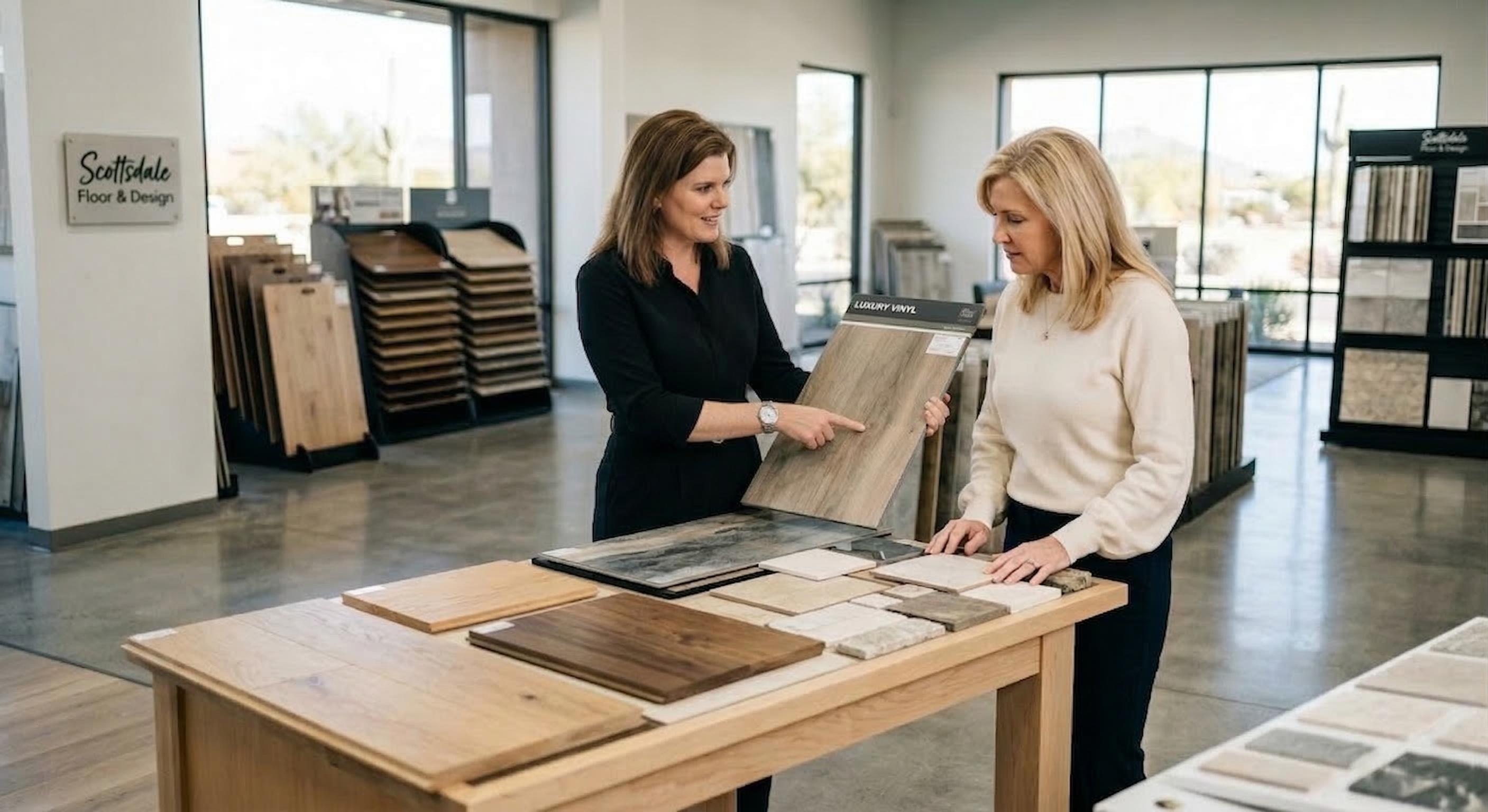
Luxury vinyl plank has improved significantly as a product category and is now a credible option in secondary spaces, rental properties, and budgets that don't support natural stone or engineered wood. Its performance characteristics in Arizona are generally adequate; it's waterproof, dimensionally stable in normal temperature ranges, and forgiving of humidity fluctuations.
The performance concern specific to Arizona: LVP has a maximum installation temperature threshold, typically around 85°F for the product itself. In unconditioned spaces, garages, mudrooms adjacent to exterior walls in full sun, or any area that can get above that temperature during installation or regular use, certain LVP products can expand, buckle, and lift from the substrate.
At the mega-luxury design level, LVP is typically not our recommendation for primary living spaces. The look and feel, even at the high end of the category, does not hold up against engineered hardwood or natural stone in a luxury home context. But for a mountain property, a vacation home, a casita, or spaces where budget and practicality are the primary drivers, quality LVP is a legitimate choice.
What to Avoid: The Clear Failures
Solid Hardwood in Primary Living Spaces
We address this in detail in our companion article on wood in desert environments, but the short version is direct: Solid hardwood flooring installed over a concrete slab in an Arizona home will struggle. The combination of extreme dryness (which causes the wood to shrink and gap) and monsoon humidity spikes (which causes the wood to expand) subjects' solid hardwood to a humidity range that most species and most installations are not engineered to survive without movement, gapping, or surface issues.
It can be done, with species selection, acclimatization, humidity management, and an understanding that you're making a choice that requires ongoing attention. But it's not the default-appropriate choice it might be in coastal or temperate climates, and clients should understand that going in.
Carpet in Primary Living Areas
Carpet in bedrooms and media rooms is common and appropriate in Arizona. Carpet in primary living and dining areas, great rooms, formal living rooms, entries, are increasingly rare in the Scottsdale luxury market and for good functional reason. Dusty desert air, combined with the dry climate that discourages carpet self-cleaning through moisture, means that carpet in high-traffic desert homes shows soiling more quickly and retains allergens more persistently than in humid climates where more moisture helps.
That said, we use carpet and area rugs extensively and appropriately, where the warmth and acoustic absorption of soft material matters (bedrooms, family rooms with media), carpet and large area rugs are excellent choices. It's the application that matters, not the material category.
Installation Considerations Specific to Arizona
The subfloor preparation for any flooring installation in Arizona deserves particular attention:
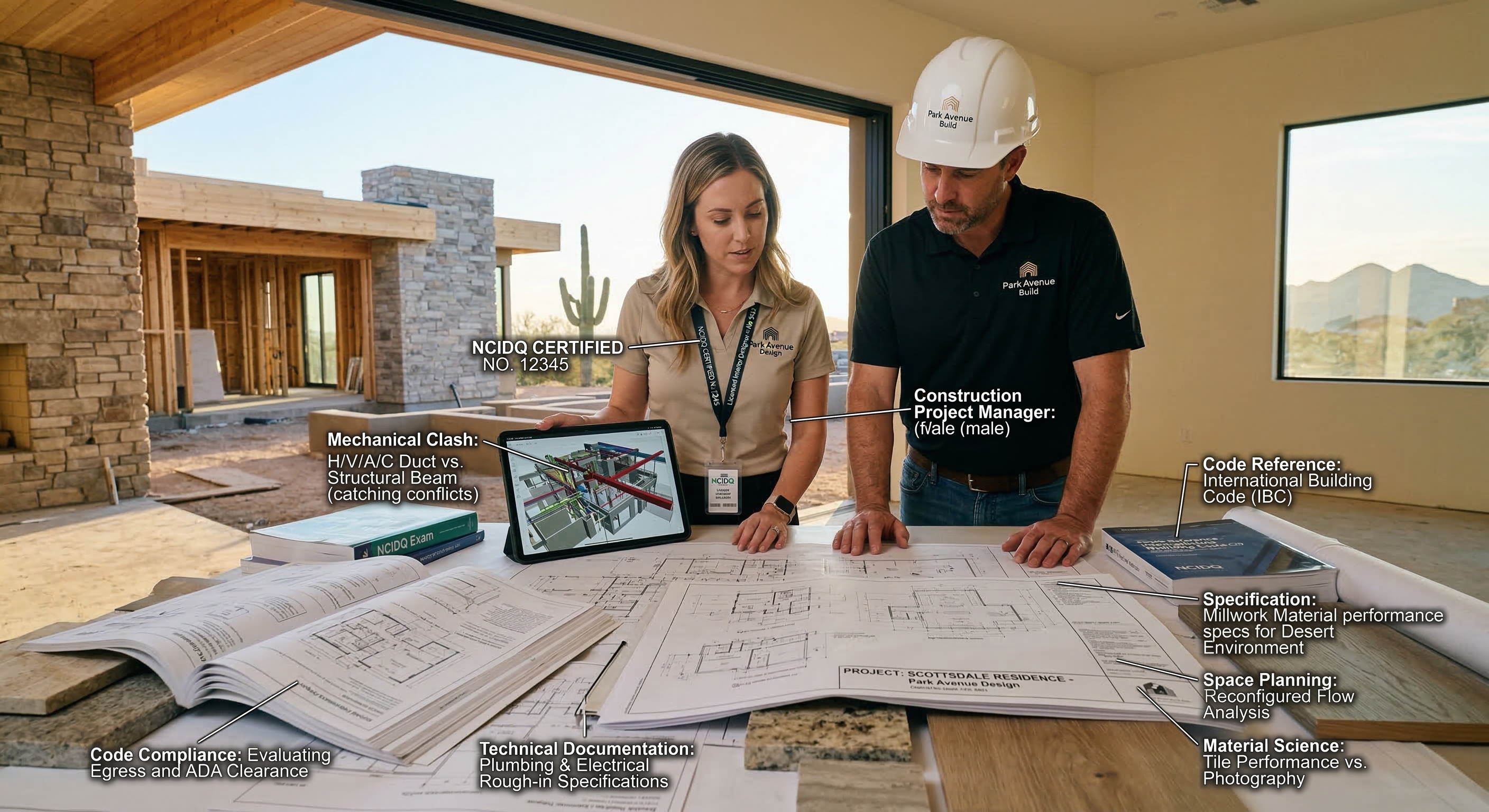
- Moisture testing of concrete slabs: Arizona's soil conditions can produce moisture migration upward through concrete slabs even in apparently dry conditions. ASTM F2170 in-situ relative humidity testing (not just the older calcium chloride test) should be standard before any flooring adhesive application or floating installation over concrete.
- Expansion gaps: All flooring materials in Arizona need appropriate expansion gaps at walls, transitions, and fixed vertical surfaces. The temperature differential between a closed home in January (68°F) and the slab temperature in August (potentially 90°F+) is significant and will cause expansion that has to go somewhere.
- Acclimation period: Wood and wood-based products should acclimate to the home's actual temperature and humidity conditions, not the warehouse or job site, for a minimum of 14 days before installation. This is particularly important in new construction where the HVAC may not yet be fully operational at design conditions.
Tariffs and Material Pricing in 2026
It would be irresponsible to discuss flooring selection in early 2026 without acknowledging the impact of current tariff policy on material costs. Significant tariffs on goods imported from China, Italy, Spain, and other major tile and stone producing countries have pushed import material costs up substantially — in some categories by 25–40% over 2023 prices.
The practical effect: Domestic tile and stone manufacturers have gained a cost advantage that wasn't present two years ago, and we've shifted more sourcing toward American-made products. Domestic quartzite from several American quarries is not only cost-competitive with imported product at current tariff levels but frankly excellent in quality. US-made engineered hardwood, always a strong category, is now particularly competitive. We track this actively and adjust sourcing recommendations as the tariff situation evolves, which it has repeatedly in the past 18 months.
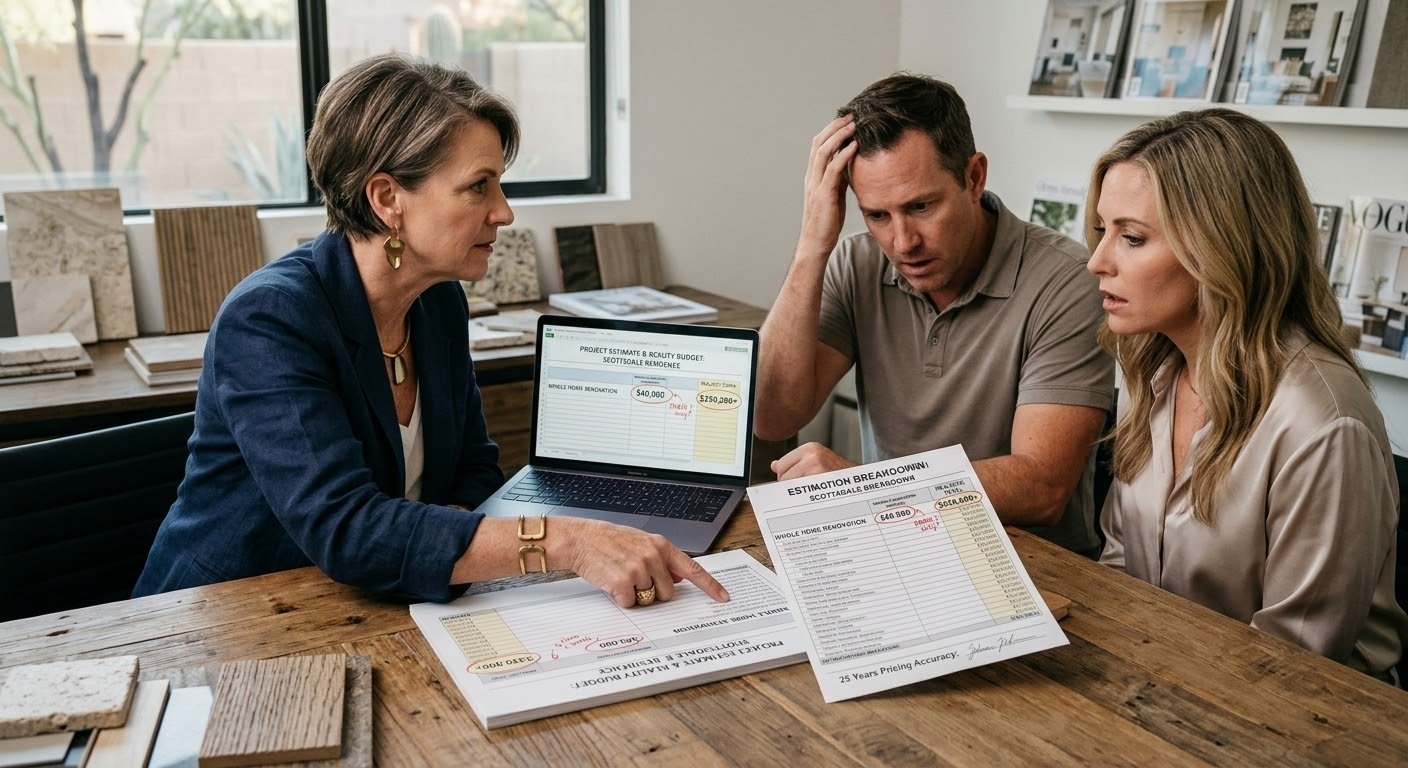
The bottom line for clients: Get current pricing from your designer. Prices that held in 2024 may not hold in 2026, and the sourcing landscape is fluid enough that a good designer with strong domestic and international manufacturer relationships can often find equivalent or better quality at a price that hasn't moved as dramatically as the imported equivalent.
Getting the Flooring Decision Right
Flooring is one of the highest-cost, longest-term decisions in a home and it's the one most likely to compound problems if it's wrong. Replacing flooring in a furnished home is enormously disruptive. Getting it right the first time, with a material that's appropriate for Arizona's specific conditions and beautiful enough to earn its place in a luxury home, is the whole job.
At Park Avenue Design, Inc. we specify flooring in every project as an integrated decision. Not a standalone specification but a material choice that works with the architecture, the color palette, the adjacent surfaces, and the actual conditions of that specific home. We've built deep relationships with both domestic manufacturers and international sources that give us access to materials and pricing that a retail tile showroom simply cannot offer.
If you're choosing flooring for a new home or renovation and want guidance that accounts for Arizona's climate realities, contact Gabrielle Roeckelein, ASID, NCIDQ at Park Avenue Design. Call (480) 961-7779 or visit parkavenuedesign.com/contact-us to schedule a complimentary consultation.
Gabrielle Roeckelein, ASID, NCIDQ — Park Avenue Design, Inc. | Scottsdale, Arizona