Every Design Trend Article Gets This Wrong — Let's Do It Right
Most "trends for 2026" content is a catalog of what's popular on Instagram this month. Which is fine, if what you want is to know what everyone else is doing. But homeowners investing $60,000 to $160,000 in a bathroom renovation in Scottsdale need a more nuanced conversation: Which trends have staying power, which are peaking and will look dated in three years, and which are genuinely excellent design that happens to also be trending.
I've been specifying bathrooms in the Scottsdale luxury market for over 25 years. I've watched trends arrive, peak, and get ripped out — sometimes by the same clients who installed them. Here's my honest read on what's being specified right now, what I'm recommending with confidence, and where I'd urge caution.
What's Currently Being Specified: A Designer's View From the Ground
Warm-Toned Vanity Cabinetry
The all-white bathroom had an extraordinary run. Clean, bright, universally appealing in listing photos dominated the Scottsdale market for more than a decade. It is, finally, giving way to something more interesting.
Warm cabinetry tones: Aged brass, warm walnut, greige with brown undertones, sage and eucalyptus greens, deep slate blues are now the dominant direction in primary bath vanity specification. Not universally, and not in every aesthetic context, but the white-on-white bathroom is no longer the default in luxury residential design here.
What I'm specifying with confidence: Warm wood veneers (white oak with a natural or light smoke finish is a particular favorite), and painted cabinetry in warm neutral or muted natural tones. What I'm specifying with caution: Very deep jewel tones in cabinetry. Emerald green and navy have been popular in the design press for a couple of years now. Some of those bathrooms are beautiful. Some will look very much "2024" in four years. If you love a deep tone, use it on a single vanity, not the whole room.
Unlacquered Brass and Warm Metal Finishes
Unlacquered brass is living its best moment in the Scottsdale market and it's one I'm genuinely enthusiastic about, with one significant caveat. Unlacquered brass ages and develops a patina over time. It doesn't stay bright and polished. For clients who find that evolution beautiful (I do), it's a spectacular choice. For clients who want consistent, uniform finish — who will feel stressed every time they see a darker spot — it's wrong for them regardless of how beautiful it is.
Polished nickel is the enduring warm-ish metal choice that photographs beautifully, doesn't patinate, and holds up well in Arizona's dry climate. Satin brass (lacquered) is a lower-maintenance path to a warm gold tone that stays consistent over time. Warm matte black has been a dominant finish for several years and is still current, though it's now clearly entering its mature phase, meaning it's safe to specify if you love it, but it's no longer the forward-looking choice.
Hardware consistency matters: Your faucet, cabinet pulls, towel bars, toilet paper holder, and lighting fixtures should all be in the same finish family. Mixing metal finishes intentionally can be beautiful when it's controlled; it looks unplanned when it happens by accident.
Floating Vanities — With Evolving Details
The floating vanity isn't new; it's been a fixture of contemporary bathroom design for years. What's evolving is the detailing. The generic 60-inch floating double vanity in flat-front white with simple pulls that appeared in virtually every renovation from 2015 to 2022 is being replaced by more considered pieces.
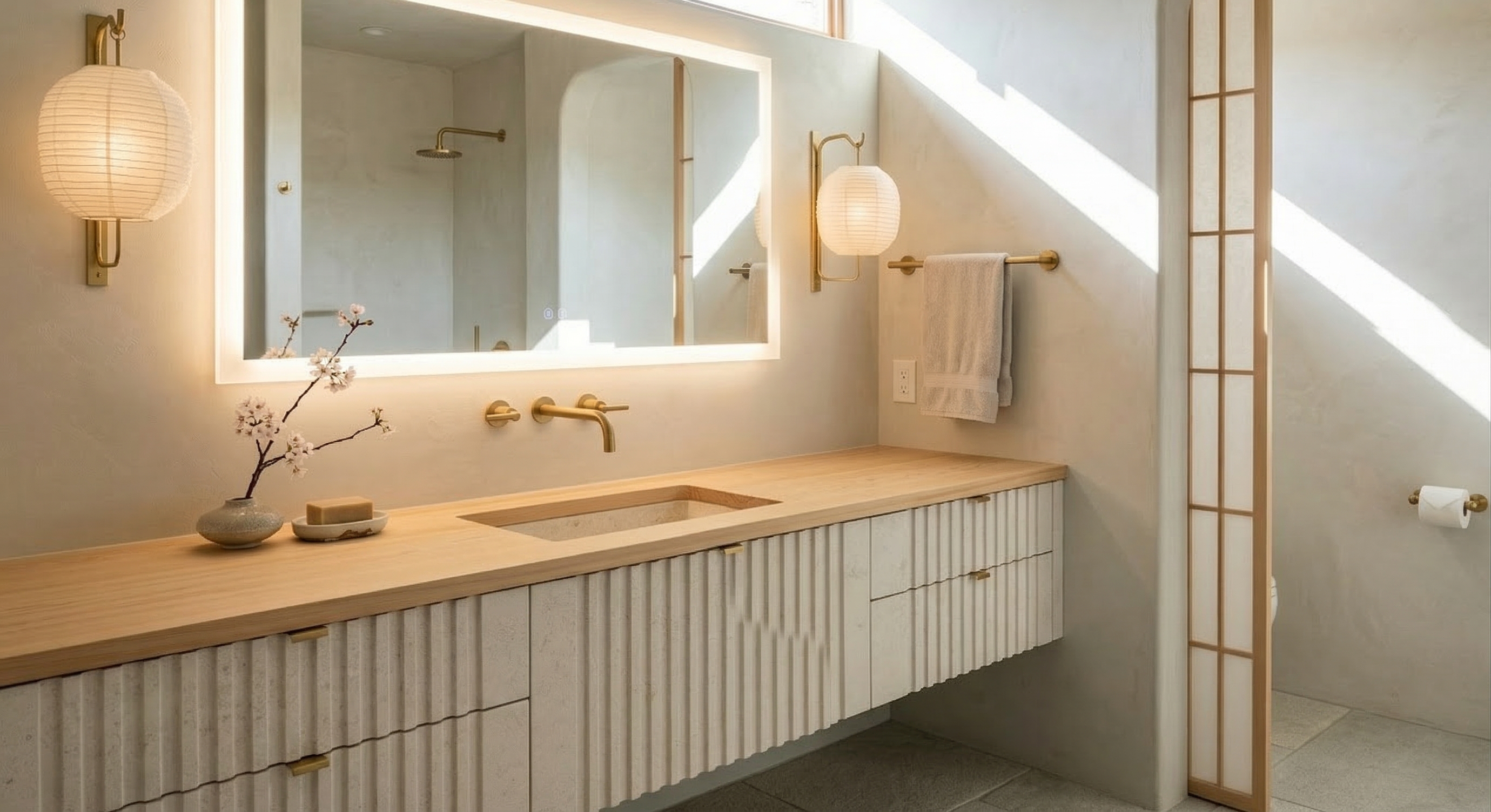
What's current: Floating vanities with a furniture-like quality; leg detail, routed panel doors, inset construction, interesting grain direction on wood-veneered doors. Visual weight and craft have returned as values in cabinetry. Flat-front waterfall-edge panels feel clean but stripped of personality at this point; a simple shaker door, an inset panel, or a fluted detail brings the cabinetry back to life.
Vanity height: Comfort-height vanities at 34–36 inches rather than the standard 32 inches continue to grow as the default specification in primary baths. If custom cabinetry is being made, there's no reason not to specify the height to match the user. Add 2 inches. You'll notice the difference every day.
Statement Mirrors Over Frameless
The frameless mirror that just covered the medicine cabinet is losing ground to statement mirrors with intentional shape, frame character, or artistic quality. Arched mirrors, the single arch over a single vanity, the pair of arched mirrors over a double, remain in heavy rotation. What's evolving: More organic, irregular shapes, and mirrors with integrated LED lighting that's visible through the edge of the glass rather than a simple backlight halo.
For primary bathrooms with separate vanities, I often specify one mirror over each vanity rather than a single shared mirror. The scale feels more considered, and each person has an appropriately sized and lit workspace. Size matters: for a 36-inch wide vanity, a mirror in the 30–34 inch range typically reads best proportionally.
Fluted and Reeded Surfaces
Vertical fluting, the shallow parallel channels that create a tactile, light-catching surface has been building in the market for several years and shows no sign of peaking. It's appeared on cabinetry fronts, on stone panels, on tile walls, on freestanding bathtub surrounds, and on decorative objects. When it's used selectively, a fluted vanity front, a fluted stone panel on the tub wall, it adds genuine craft and visual interest. When it's used on every surface simultaneously, it reads as trend-driven rather than considered.
My rule: Fluted detail on one primary surface per space. The vanity, or the tub wall, or a niche detail in the shower. Not all three.
Integrated Shelf Niches and Built-In Storage
Vanity storage has expanded beyond the vanity cabinet itself. Recessed wall niches, built into the wall between studs in standard construction, or into a furred-out wall when studs don't align provide open storage for daily-use items without the clutter of items on the counter. A floating shelf in a niche beside the mirror, a deep recessed niche above the toilet, a pair of flanking niches beside the vanity: All of these are common specifications in current primary bath projects.
The tile detail inside a niche is a design opportunity often missed. A niche lined in a contrasting material such as a mosaic tile, a stone slab cut-down, a decorative field tile reads as intentional rather than functional-only. The cost premium is minimal; the visual impact is significant.
What I'm Recommending Less
A trend article that doesn't address what's wearing out its welcome is incomplete.
- Shiplap in bathrooms: Beautiful in some contexts; has been so broadly imitated that it now reads as a specific era rather than a timeless choice. In Arizona, where humidity is low and the aesthetic tradition is Southwestern or contemporary rather than farmhouse, it frequently reads as out-of-place.
- Rose gold fixtures: Had a significant run. Now in visible decline. If you love it and plan to stay in your home for 20+ years, make the choice because you genuinely prefer it. If resale matters to you, the safer warm metal choices are brass and polished nickel.
- Overly busy tile patterns on every surface: Statement tile on a floor, a shower wall, or as a backsplash is excellent. Statement tile on the floor AND all four walls AND the shower ceiling simultaneously is visually exhausting. One dominant material, with the others supporting it.
- Vessel sinks: Still available, still specified occasionally, but the peak was a decade ago and they've never fully come back. The undermount and integrated sink have largely replaced them in new installations. Some vessel designs are genuinely beautiful; most read as dated.
What Has Staying Power Regardless of Trend
After 25 years of specifying bathrooms, the elements I trust to age well:
- Natural stone in classic colors: White marble, warm limestone, soft gray quartzite. These have been in beautiful bathrooms for centuries. They'll outlast any current trend.
- Inset cabinetry construction: The door sits flush with the face frame rather than overlaying it. It requires more precision and costs more. It looks like quality in 10 years the same way it does on day one.
- Dimmable lighting throughout: Not a trend — a functional imperative. A bathroom that can move from bright task lighting to gentle evening light serves the space's full range of use.
- Radiant heated floors: In Arizona's mild winters, this might seem unnecessary. For anyone who has padded barefoot across a heated stone floor on a January morning, it's immediately understood as worth every dollar. Radiant floor systems run $8–$15 per square foot installed; in a primary bath, the total addition to the budget is typically $3,000 to $7,000.
The Budget Context
Vanity cabinetry, customized, typically represents $8,000 to $25,000 of a primary bath renovation budget, depending on the size of the space and the complexity of the cabinetry. Hardware (fixtures, pulls, towel bars, accessories) in quality finishes runs $2,000 to $8,000 for a fully equipped primary bath. These line items add up within a renovation that typically totals $60,000 to $160,000 for a luxury primary bath in Scottsdale.
Ready to Renovate Your Bathroom?
Park Avenue Design, Inc. approaches bathroom renovations with the same discipline applied to every project: Understanding how you live, what will perform in Arizona conditions, and what will still look right in fifteen years. Gabrielle Roeckelein, ASID, NCIDQ offers a complimentary initial consultation. Call (480) 961-7779 or visit parkavenuedesign.com/contact-us.
Gabrielle Roeckelein, ASID, NCIDQ — Park Avenue Design, Inc. | Scottsdale, Arizona